MIDI Innovation Awards 2026 · Software Prototypes · Public voting 8–22 SeptemberVote for Conductor →
CONDUCTORMIDI Innovation Awards 2026
MIDI 2.0 · IN THE ARCHITECTURESTANDALONE · AU · VST3

Play the wholeorchestraat once.

Every desk of the orchestra is a discrete recording, so one MIDI chord divides itself across real players. Add or remove players in real time, while you perform.

DESK01DESK02DESK03DESK04DESK05DESK06DESK07DESK08SOUNDING PLAYERS · JOYSTICK5 / 8 · CONTINUOUS3 / 8 · CONTINUOUSMIDI IN · ONE CHORDDIVISI · RE-ALLOCATES AS NOTES CHANGE
One chord · Desks dealt live
↓ SCROLL · THE INSTRUMENT
LOS ANGELES · CAv.2026
02The instrument

Every desk is
a discrete
recording.

On the work

Conductor is the software instrument Audio Impressions built to play its own orchestral libraries, in which every desk of every section is a discretely recorded performance. The recording method and the processing were designed together, which is why the processes work at all.

Three processes, covered by patents, make those recordings behave as an orchestra. None of them is an effect applied afterwards to a blended stereo section.

03
Processes · Patented
2.0
MIDI · In the architecture
01
Keyboard · The whole orchestra
Input
Keyboard
MIDI 1 · MIDI 2.0
Ensemble
MIDI inserts
notes + CCs
Sections
DIVISI split
deals to desks
Desks
Discrete recordings
one player each
Room
Mic bleed
placement · space
Out
Output
audio
03The processes

Three processes,
one orchestra.

All three processes are ours, and the libraries were recorded for them from the very first session. Each depends on the desks being recorded separately.

Granted · EP 2 122 60601

DIVISI

Distributes incoming MIDI notes across the individually recorded desks, in real time. The section divides the way a real section divides, and re-divides as notes are added and released.

Multi-layeredRe-allocates liveSwitchable off
Patent pending02

IR / IIR

Models mute types. The dynamic slider ties mute character to the performance's own dynamic, so the instrument's voice changes as the players push.

Mute typesDynamic sliderIR ⇄ IIR
Granted · US 7,702,11603

Room

Simulates the microphone bleed that binds separate players into one ensemble in one room, and places the result in space.

Mic bleedProximity micsPlacement
04What MIDI does here

MIDI is the
mechanism.

A chord arriving at Conductor is allocated across discrete desks as you play. Because every desk is its own recording, the number of sounding players can change while music is sounding.

MIDI 2.0 · In the architecture

Mechanism, not connector.

High-resolution control is what lets divisi re-allocation, ensemble-size changes and IR/IIR sweeps read as musical gestures rather than stepped ones.

MIDI 2.0High-res controlJoystickMIDI-CI
01

Live division

One chord is allocated across discrete desks in real time, and re-divides as notes are added and released beneath your hands.

02

Joystick

Continuous control maps to the number of sounding players. A controller move adds or removes real players rather than fading a layer.

03

Humanize

Varies the individual desks against one another, by the same means. Provisional patent.

04

DIVISI off

Each section becomes individual stems with shifted play ranges, transpose, added octaves and foldback. One keyboard, a full orchestral split.

05

Polyphonic legato

Reads overlapping notes across the whole chord rather than one line at a time, so real playing produces real legato.

06

MIDI-CI

Conductor publishes the Note On Orchestral Articulation Profile, so a MIDI-CI initiator can discover each section's articulations.

05Inside Conductor

Ensembles, sections,
desks.

Build ensembles from the library, section by section. Every desk is a channel in the mixer, and the controllers deck puts the joystick, faders and presets under one hand.

Library · Ensembles

Player

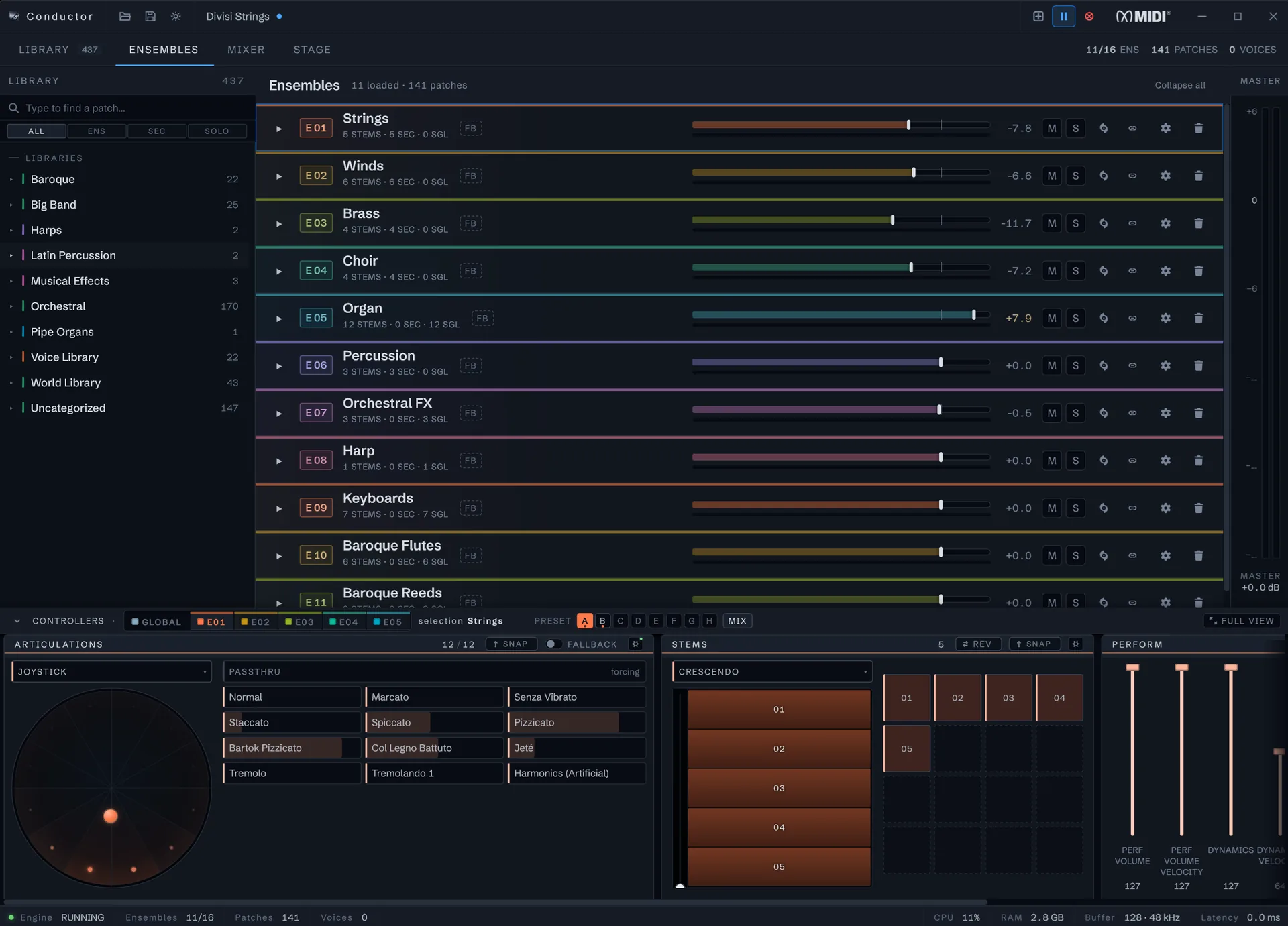
The library on the left, the ensembles on the right. Drag a patch into a section and it becomes a desk.

Conductor player view
LIBRARY · ENSEMBLES
Library rail
Every collection with its patch count. Search, then filter by all, ensembles, sections or solo instruments.
Ensemble rows
Each ensemble shows its stems, sections and singles, with gain, mute and solo on the row.
Deck in reach
The controllers deck sits under the list, so articulation, stems and perform faders stay in view while you build.
Mixer

Mixer

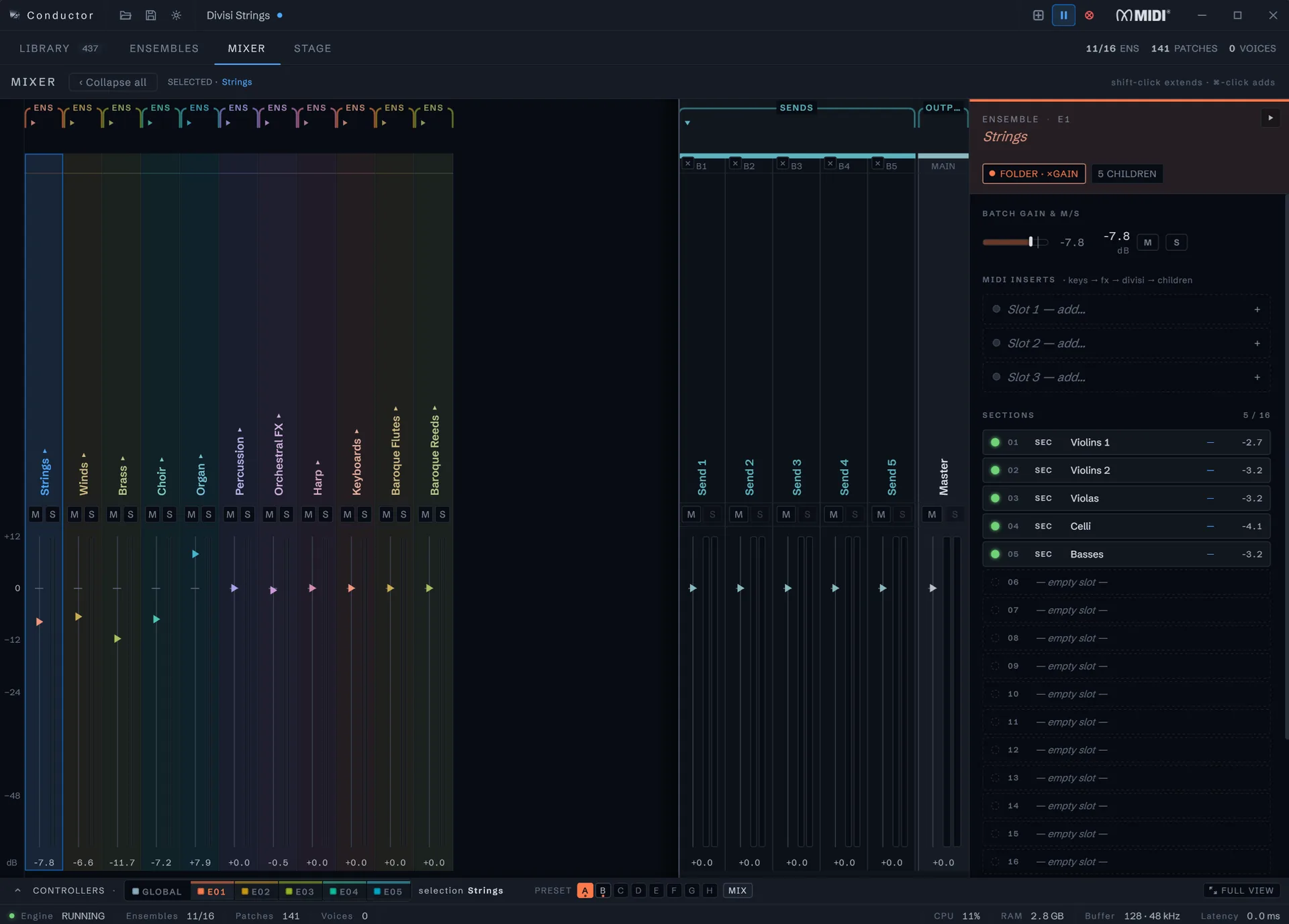
Every desk is a strip. Every folder is a MIDI stage. Third-party DSP and MIDI plug-ins go in as inserts.

Conductor mixer view
MIXER
Strips per desk
Ensembles, sections and desks each take a strip with meter, gain, mute and solo.
Sends and outputs
Five send buses and the main output sit beside the strips.
MIDI inserts
Folders carry MIDI inserts that run before the divisi split: keys, then effects, then divisi, then the children.
Sections
The selected ensemble lists its sections with level, sixteen slots deep.
Articulations · Live

Controllers

This one is live. It is the articulations panel from Conductor's deck: nine articulations under one hand, blended by a joystick or run as a ramp.

Live · Articulations panel
Joystick
Drag the puck. The zones it leans toward bloom and the rest fall away, and each cell's bar reads the same number the ring does.
Crescendo · Cascade
Switch the mode and the pad becomes a ramp. A crescendo builds through the mapped articulations, a cascade runs a window across them. REV flips the start.
Map and unmap
Click a cell to take an articulation off the stick or put it back. PASSTHRU hands control back to the incoming MIDI.
Snap
Makes the control momentary. Let go and the puck springs to centre, the ramp to its origin.
The engine · Orchestral Art Live

Our own sampler,
native to MIDI 2.0.

Conductor plays through Orchestral Art Live, the sample engine we built ourselves rather than a hosted third-party sampler. It speaks UMP end to end, so articulations, attributes and high-resolution control arrive at the note, not the preset.

MIDI 2.0 nativeUMPStandalone · AU · VST3
UMP end to end
Native MIDI 2.0 endpoints from the controller to the voice, with no MIDI 1 staging inside the engine.
Note-level articulation
Every instrument, articulation and alternate is addressable from a UMP note-on attribute. Switching happens per note, without keyswitches.
Tree playback
Instrument, articulation, round-robin alternate: one hierarchy that the DIVISI desks are dealt into.
Discoverable
Publishes the Note On Orchestral Articulation Profile over MIDI-CI, so a controller can ask the engine what each section can play.
06The libraries

Recorded for
the processes.

From the first session, every section was captured desk by desk, with DIVISI, mute simulation and Room in mind.

Strings · Winds · Brass · Orchestral percussion
Pro Arte Orchestra · Phoenix Studio, Wembley
Choir
Lisinski Hall, Zagreb
Pipe organ · Nine-foot Steinway
Auckland Town Hall
Big band
Lansdowne Studios, Holland Park, London
Drum kits
Bill Schnee Studio, North Hollywood · York Street Studio, Auckland
Guitars · World
Chris Stone's own studio
Core libraries
Divisi
Strings · Winds · Brass · Big Band · Choir
Percussion
Orchestral · Latin · World · Drum Kits
Guitars
Acoustic · Electric · Bass
Keyboards
Acoustic · Electric · Pipe Organs
Sound
Orchestral FX · Sound Design
08Founder

Christopher L.
Stone.

FOUNDER · COMPOSER

Studied composition with Nadia Boulanger, and conducting and orchestration in Vienna. His first film score, in the mid-1960s, made him the youngest member of ASCAP.

Since then, more than two thousand television episodes and numerous films, and multiple ASCAP awards for most-performed background score, earned while scoring five series at once.

He composes by watching the picture and improvising to it live, direct to the DAW. Conductor exists to serve that way of working.

FILMS20+
TV SCORES2,000+
ASCAP AWARDS6×
09Contact

Contact the studio.

chris@audioimpressions.com